Look to it brothers and sisters;
Look to the fire that illuminates the ending of the darkness.
As it climbs and ascends the edge of our awareness at the edge of our worlds and minds,
always remember that while its warming fingers
may caress our cheeks:
those same delicate touches
can so easily become blades
that cut and rend the very souls.
Know of it mothers and fathers;
this thing is both benign and deadly, to friend to foe and to strangers.
For as it has no pity, so too does it lack malice, knowable or unconscious.
Something that simply is cannot be bound by judgement nor value that it does not possess.
So walk with and follow me my sons and my daughters;
Follow this only guide we all have to keep at bay the shadows of the minds and the lands.
Until we light our own fires within, we have no choice but to trust.
Trust that which remains unaware unmoved uncaring by our existence our living our very being.
To blindly rely upon a power not our own is to feel, but not to know.
To think we grasp, but not to truly understand nor comprehend.
It will be a perilous journey though blackness to find illumination.
Until all that remains is what is what was what may yet come to pass.
Sunday, June 9, 2013

Friday, June 7, 2013
Hero or Anti-Hero: Therein Lies the Rub
In terms of
relatable story characters, nothing really seems to beat the Anti-Hero. If you
need someone to swoop down from on high and save everything or everyone that
needs them, even if it means that they must be put in difficult positions and
tax their moral stances to the utmost, these are often not the people you want
to turn to. In fact, you had best hope you don’t stand in their way for any
reason, because if they’re put in a corner, they’re not going to dig deep to
find some hitherto unknown well of courage and strength just waiting to come
into being. They will look for solutions. They will gradually (or rapidly
depending on the specific character) stop caring as to why you are standing in
their way. They will take you into account. And then one way or another, you
will be dealt with.
Now, I don’t
have a lot of sarcastic clip art or demotivational posters or even any links to
any dictionary definitions. Mostly because this is going to be third person
anecdotal about stories that are not widely available for free on the internet,
but also because this is something of a personal subject for myself. So without
further ado, let’s get right to it.
Whether
people admit it or not, their imaginations demand two things of them. A
purposeful story. A story with a pattern and a reason behind many if not all of
the things that happen within its framework. And secondly, their imagination
demands an increasingly complex framework for the underlying simple stories
that they tell and hear in turn. Don’t believe me? Think of one of your
favorite stories. Take your time, I’m in no hurry. For me one of my absolute
favorite stories is Catch-22; the quintessential parody of
war novels that still manages to make points that you almost think to yourself
seem entirely incidental to the entire overall arc, disjointed as the narrative
structure may be.
It is
ultimately the story of a single bombardier who becomes increasingly
disillusioned with the war effort and who ultimately deserts when the
opportunity presents itself to him. A very simple premise at its core. But it
introduces characters both major and minor that make it the world the story
inhabits increasingly and mind-bendingly complex. So complex in fact, that the
title became a synonym for an unwinnable situation where no positive outcome is
possible.
But in any
case, when the framework demands complexity and depth one of the only
reasonable places to look for it is in the main protagonist. One of the reasons
that Greek mythology continues to fascinate even today, and why even Norse and
Egyptian stories continue to circulate in the popular consciousness despite
having virtually no recognition as major religions anymore is certainly not
because of its historical significance. If that were all that was to it, so
many other religions would have survived as well, if only to keep a clear and
accurate timeline in mind when looking at the evolutions of human belief
systems.
So many of
the more fascinating stories that get taken into the hive mind of pop culture
and endlessly permutated and examined and rehashed over and over are not the
more traditional heroes, such as Perseus who slew the Gorgon or Theseus who ended the life of the minotaur in order to end the suffering inflicted upon Athens by Crete. (And even they had their more questionable moments...) No, it is their more questionable
companions such as Heracles, Achilles and even Odysseus. An extremely strong
man who only performs some of his most memorable and famous actions to avoid
being sent to the Hellenistic version of Hell, a man who chose eternal glory
over family life and dragged his defeated opponent Hector’s corpse around the
walls of the city behind a chariot before leaving his body to be eaten by
carrion purely to spite Hector’s family and a man who slaughters all of the
suitors who had attempted to woo his wife after he had been presumed dead for
over a decade as well as any handmaidens who had been ‘weak’ enough to fall for
their charms.
I don’t
know about anyone else, but that doesn’t sound like the actions of a very
heroic person. And yet still Heracles’s 12 labors are one of the most memorable
stories of ancient Greek heroism. Achilles is still considered such a sufficiently
awesome figure that he had metaphorical and physical weak spots named after his
heel. And Odysseus’s actions to, during and coming home from the Trojan War are
quite literally the stuff of epics. So what is it about characters like this
that attracts and inflames the imagination even when the characters themselves
are not particularly heroic?
It is
precisely the fact that they are not strictly heroic that makes them so
relatable, so interesting. Ultimately, despite their flaws and (sometimes
numerous) failings, they continue onward. They do things that we’d consider
questionable for dubious reasons, but they are still fundamentally good people
at their heart. They mean well. Mostly.
Even their
ideas of divinity weren’t beyond this treatment. The ancient gods were skirt
chasing, petty, easily angered juveniles who could take offense if you so much
as sneezed on their boots while licking the soles. But they could be kind too.
Aphrodite’s bring Pygmalion’s statue to life comes immediately to mind. As well
as Zeus’s bringing Dionysus to Olympus after accidentally killing his mother
and Hera’s willing adoption of Heracles. Not perfect by any means, just like
real people. And because of that constant striving for but equally constant
falling short of perfection, they were also far more relatable. Far more
understandable.
Complexity
which surrounds simplicity. Light and Darkness intertwined to create not one or
the other but a shade of grey. Unreality the skitters the edge of knowledge.
Fantastic creatures and actions that are driven by comparatively mundane and
straightforward thought processes. All of these serve to make the Anti-Hero in
many ways far more fascinating than the traditional protagonist of many a tale.
But that is a story for another time…
Wednesday, June 5, 2013
Dualism in Lycanthropy: A Synopsis
When people imagine supernatural
creatures, they don’t often imagine there could be two sides to them. Not using
the original material anyway. We don’t see people talking about how Dracula
might’ve had one of his brides rebel against him in order to protect humans or
hear speculation about how the creature might’ve been harassing his creator and
killing his family in order to prevent him from continuing to play god and thus
save humanity from being overrun by the inexplicably reanimated dead. But that’s
not so in the origin of the word Lycanthrope aka The origin of most well known
mythological creation/exploratory stories aka Greek “Hellanic
Yes” Mythology.
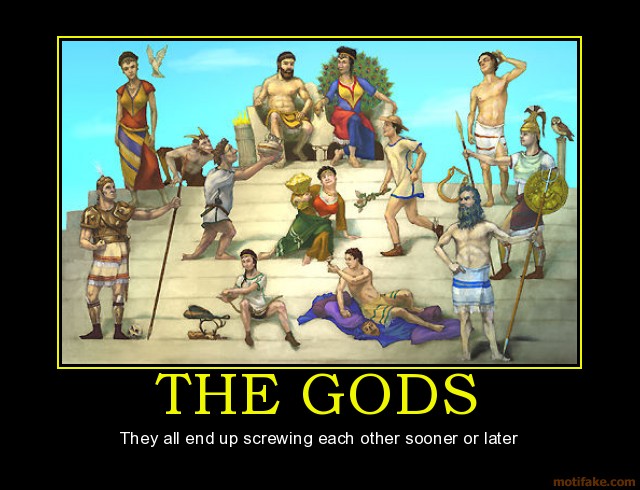
In Greek Mythology, there is one
original story for where werewolves came from. That is the story of king
Lycanos, the cruel king who verbally talked of disbelieving in the same gods
who had managed to lay waste to cities and turn a once beautiful priestess into
something so horrendously ugly that she turns to stone anyone who looks
directly on her and burns her image into any surface that reflects it back.
Zeus came down in mortal form and attempted to have him recant his doubt of the
gods. Lycanos, reasonable and logically thinking chap that he is, decides he’s
going to test the divine power of his guest by killing one of his sons and
feeding his flesh to the guest during the feast. Because cannibalizing your
children is usually the best way to
prove a possible god in mortal form is in fact a crazy man who’s off his meds.
Mostly.
Zeus, instantly remembering that
distasteful dining experience from the dive bar a few weeks back, instantly
recognizes the smell of cooked kid and so cursed Lycanos to become a wolf in
order to reflect his true ‘inner
bestial nature.’ A cruelly fitting end to a fittingly cruel man. And it
seems reasonable to assume that is the only instance of manmade monsters, or
monsters in man form. But that isn’t quite true, for in my mind there is still
another possible source of werewolves in Greek mythology: one who most anyone
even passingly familiar with the genre of ‘for the
love of everything holy, don’t ever spy on naked female dieties’ could
recognize. I am of course, talking about the story of Daphne the nymph
preferring to get turned into a tree rather than be yet another one hour stand
of the original sensitive musician god Apollo.

No wait, that’s the recognition of
another bad habit a lot of the male half of the pantheon seem to get into,
though I can’t for the life of me think of a name for it. No, the
story I’m thinking of is the story of Actaeon and Artemis. The hunter,
searching through the woods with his hounds, stumbles upon a sacred bathing
site of the goddess of the hunt. And so manages to see her in all her godly
glory. Apparently it wasn’t that much of a godly glory to see since she had to
personally intervene instead of simply waiting for her godly aura to vaporize
him ala Zeus in what is colloquially known as: “No wonder the wine god
constantly needs to get hammered in order to forget where he came from.”
Turned into a stag, his hounds chased and eventually tore him apart, seemingly
of their own will. But there are ancient beliefs that believe that if one
followed the teaching of Hecate, the ancient Titaness of witchcraft and
crossroads, there was a way to use the pelt of the wolf to transform into its
form.

Now, imagine that a wolf/dog/canine of some sort, managed to ingest the
flesh of man touched by the gods. There are all sorts of stories of gods
accidentally creating miracles and beings with their blood, skin, bone and
other…less savory body parts. (Aphrodite being said to be a combination of
Kronos’s gelded bits and sea foam springs queasily to mind.) Who’s to say these
same dogs, who are named and given identities in the original myth, could not
have been transformed by one goddess’s thoughtless curse? Who is to say that
these animals would not be trapped in the form of men, condemned by their own
nature to be stuck between two conflicting states to repent for murdering the
man who had taken them in? After all, the gods weren’t exactly particular when
it came to divine retribution. Much like many deities before and after them,
their mindset seemed to follow more along the lines of ‘general area
effect’ rather than ‘single person effect.’
And in any case, doesn’t that make
them so much more interesting? The idea of an animalistic man and a pack of
humanistic animals? I don’t know, maybe it’s just me.
Monday, June 3, 2013
Choice Background Expansion in the Name of NPC Awareness and Respect
If we’re talking about choices and consequences this week,
let’s talk about choice making video games. Because what better way to prove
that I’m a mature person than by taking a potentially serious topic and body
slamming it back down into the mat of childhood immaturity and giving it a rug burn
of utter…something to do with stereotypical assumptions of videogame player’s
inherent immaturity.

But in any
case, some of the best videogames I’ve ever played were ones where there was an
aspect of choice and player determination that felt like it affected the story
behind it. I’ve never really gotten into PC games such as World of Warcraft,
Mount & Blade or the Sims because the world is too open. Does that make
sense? No, of course not. After all, whoever heard of a thing as too much choice?
Don’t get
me wrong; if you want to play god, those games can definitely let you delude
yourself into believing it for a day. Or six. But ultimately, they have so much
choice that all the choices you make start to feel the same, that it becomes
too much like real life where many infinitesimal choices ultimately end up
weighing you down like a thousand pounds of feathers that never seem to matter
until they all lump together in a giant congealed…pillow…thing.
Games like
Alpha Protocol, Heavy Rain or inFamous on the other hand try to find a balance
between linear and open. In Alpha Protocol’s case, the freedom is expressed in
the player’s choice of background and interaction with a fairly linear settings
both within the context of the characters and the story that makes it feel like
part of a true espionage rpg.
In Alpha Protocol, you can choose
Thorton’s background and make him as awesomely stealthy or cringingly brazen as
you want but either way, you are a part of something bigger than yourself in
every aspect that while you affect and have a stake in, ultimately cannot end
on your own no matter how great you are. It leaves itself wide open while never
allowing the player to become paralyzed by indecision of how to piddle around
with the tranquilizer gun in order to make unconscious enemy soldiers wake up
in compromising positions.
In Heavy Rain, the interaction
between their characters, how quick their reflexes are and how much the one who
controls them believes they deserve to suffer or be rewarded is like taking a
microscopic look into a miniature drama between characters in the sims if the
sims could speak English and were significantly more memetic.
And in inFamous (1 and 2) how the
player controls Cole McGrath aka “The Electric Man” aka “The Demon of Empire
City” aka “The
Glitter Explosion that still lost to the Biology Experiment Riding
a Unicorn” directly affects what powers they can use to further their own
play style, their electricity turning either bright ocean blue or dark bloody
red depending on whether they decide they’ll treat the game as a hero fantasy
or grand theft auto with electricity catharsis.


All of these games have a world,
that while fairly linear and enclosed when viewed objectively, create an
atmosphere and background of underlying depth that allows the player to feel as
though they’re part of something bigger without overwhelming them with choice
and decisions. Just the way life could be…if that weren’t such a terrifying
prospect for everyone who’s Not the
main character of the world videogame.
Maybe you’d be the main character
in a videogame, maybe you’d be an npc. Personally, I love the genre, but that’s
not really the kind of world I’d want to live in. After all, as Danial O’Brian,
regular editor and writing contributor of cracked.com once said: “You
wouldn’t be the 17 year old lesbian cult leader, you’d be the water tower
painting peon.”
Friday, May 31, 2013
Sophisticated as Hell Literature: The Mossy Knight of Truthiness
Quick Survey: Everyone who follows Medieval poetry not assigned in a
college class to make you a better rounded person in between bouts of
stupefying bewilderment as to how such old writing written on simple
sheets of paper can make your brain feel as though it's being crushed
under a lead brick, raise your hand.
I thought as much.
For those of you not familiar with the story I'm about to follow along and simplify: Sir Gawain and the Green Knight is considered a classic of Arthurian Legend. It focuses primarily on the old "You lop off my head, I get to give as good as I got" sort of story that seemed a bit too common in ye olden legends of Europe to be entirely coincidental.
"But wait! This one is different." says the undead monk who wrote the blasted thing and whom I shall henceforth refer to as Father Sandwichbread.
"How So?" I ask, whilst slowly edging toward the nail clippers I keep near my bedside just for this occasion. "Sir Gawain shall not be decapitated unless, wait for it..." Sandwichbread pauses, mostly to collect part of his left hand that has spontaneously dropped off, leaving a rather mildewy looking stain on my nice hardwood floor. "Unless he lies!!" Pausing for a second, I raise my right eyebrow to express vague incredulity.
An awkward silence ensues. "Maybe you should have a better twist than that." I tell him gently, hoping he won't remember that he is in fact a proper English zombie on American soil, which thus entitles him to the unfortunately very real Ziplomatic Zimmunity. (Get it? Cause he's a zombie. And everything involving zombies has to involve either extra attention to decay or some obviously hackneyed insert of the letter Z where it doesn't belong, like when the LAPD sponsored an episode of Sesame Street. Can you spell 'force?' Yes we can! 'E-X-C-E-S-S-I-V-E!')
"Oh, just go on with it." The newly undead Father sighs, unceremoniously plopping his mouldering keister into my nice computer chair. So, with little choice left to me, I begin the story. I mean, poem. I mean- "Get on with it!!" Roars Sandwichbread, completely unaware of the metajoke he unintentionally made.
Our poem begins with a brief foray into Roman history, how old I-need-a-knee ("Aeneas!" Corrects Sandwichbread.) and Romulun ("Romulous!" pipes up the increasingly annoyed maggot receptacle.) all relate to a man called Happy Brutus. And already, we're off to a ripping good start, making it clear that the extremely masculine warrior race that 'bred there' (there being Non-Roman controlled Britain) was founded by a man named after a person whose name is a virtual whole-wheat substitution for the word traitor. Mostly because trying to append the Americanism to the Shakespearean phrase that spawned it, you make it sound more like an elderly waiter clarifying a regular named Arnold's order.
In any case, all the 'most chivalrous and courteous knights known to Christendom' are all gathered at their good poindexter Arthur's place, mostly because the man is literally King of all he surveys and in spite of his nice guy personae, I would think most of them do remember that if they so much as stare at him cross-eyed during this time period, he could have them killed, or worse, exiled. No wait, scratch that, reverse it.
Evidently the new year was rung in with gratuitous kissing on all parties involved knight and lady alike. Except of course, Arthur. Since he A) never seemed to realize that one of a royal line's primary functions is to be sure to continue to exist also known as 'For Heaven's Sake, Why Is There Not An Heir Yet?' Syndrome and B) never realized until God literally spelled it out for him that some future author's poorly written self-insert with no respect for the rules of decent writing would have the entire plot change retroactively. Or to put it in simple terms, Arthur does not yet realize that the supposedly beautiful and loving Guinevere will be made to fall deeply, madly and inexplicably in love with a 12th century Frenchman's idealized version of himself a.k.a Lancelot.
Now, skipping past the lurid descriptions of English cuisine that even when he was alive Father Sandwichbread knew no one would tolerate for more than half a page, a slender giant of an alarmingly handsome man plated all out in ceremonial armor that looks to have been bronze left outside for a couple of decades enters the hall. I'm not kidding with that description by the way, Sandwichbread sighed longingly just now when I read the passage describing the beautiful, muscular but slender figure. (All two and a half pages of it.) And at least now I have an answer to the question of where she comes from.
Since it is Yultide and the red-eyed Mossy Tin Man is apparently all for a good game of sport, he challenges King Arthur's court if there is among them anyone who is man enough to endure an insanely brutal and almost certainly idiodic ritual known as Marathon Jousting. No wait, that would've been the decision of someone who hasn't consumed vast quantities of eggnog and has thus come to the entirely sober conclusion that offering to go tit for tat except with beheadings is a reasonable way of testing one's mental mettle and physical fortitude.
When no one takes him up on this ridiculous 'test' that even the most die-hard fraternity in the world would object to on the grounds of being absolutely stupid, Moss-Shoulders scoffs and taunts the collective round table. Arthur, rational, cool, level-headed chap that he is, immediately leaps to his feet and offers to cut his filthy lying head off for him. Deciding that this is no way to settle a possible dispute with what is by now a fairly obvious supernatural or at the very least inhuman guest, Gawain stands up; he claims that since he is a legacy admittance to the round table, and a weak one at that, he should be the one to strike the blow instead of their beloved King. The other knights, moved by his courage and selflessness all insist that they must be the one to deliver the fatal blow so that Gawain shall not stand alone in the face of such potential death.
You thought I was serious didn't you?
Ha! No. Instead they cheer him on like a bunch of rowdy football fans with nothing better to do with their Thursday afternoons. Apparently, since Arthur really couldn't be bothered to remain the least bit dignified, they figure what the hey and so encourage Gawain to totally do it, it'll definitely work out without killing you bro. Like, for reals!
As promised, Gawain delivers the blow. And as promised, the Tin Man takes it without flinching. "Also as promised, the Knight of the Green Chapel tells Gawain how to find him and who to ask for!" Interjects Sandwichbread, startling me badly as I smell the stench again after having steadily ignored it for the past hour. A quick fabreeze spray to the mouth has the rotted Father literally hacking and coughing his lungs up on my dresser, but lets me get back to finishing this tale of people with the worst case of genre blindness I've ever encountered.
After countless days journeying to Wales upon his faithful steed Gringott, who only gets named once they near the suspiciously convenient castle of "Not Green Chapel," and heroically hunting down the wild animal population in such a transparent effort to disguise the fact that he didn't take any previsions with him when he dramatically rode off into the wilderness from Camelot that the mere recounting of every not-human creature he killed would take up even more time than it already has, he finally reaches a place that claims not to be his destination, but is close enough that Mapquest counts it as a win.
Three quarters of a page dedicated to architectural admiration later, Gawain is invited inside by the most creepily friendly bellhops this side of Disney. Every single person in the castle is relentlessly jovial and so willing to bend over backwards to accommodate Gawain that it almost seems as though they know he might die soon...as if...they know something about, say about a hypothetical mystical immortal knight, that he doesn't. But that's just crazy talk right?
"Not at all-" Begins Father Sandwichbread.
"Don't spoil it!" I admonish sharply, smacking his left knuckles with my Emergency Disciplinary Ruler, and in the process accidentally knocking them clean off yet again.
Gawain is introduced to the most classic symbol of temptation, a dalmatian fur coat. No wait, that's the most classic symbol of excess. He's introduced to the lord of the castle's wife who is so pretty that, in spite of Gawain being as virtuous as he is, he cannot help but think extremely uncomplimentary things about her grandmother. The lord of the house knows that the Green Chapel is only about two miles from where he lives, but tells Gawain that he shall show him the way 'when the time is right.' That's an exact phrase from the story by the way. And yet, Gawain still manages to mistake his laughter for jovial instead of sinister.
And as the huntsmen ready their bows for the coming chase the horn sounds in the quiet. The bucks and deers alike lift their heads in nervousness, knowing the fate that awaits them this day as the slings and arrows and blades of men and fangs and calls of the hounds shall come chasing after them; their natural born nemeses gleaming furs shining alongside the won pelts of their former kinsmen adorning the merciless hunters when-
Sorry, the pulseless Father was a bit of a hunting enthusiast. But back at the plot, Gawain is startled by the Lady of the house visiting him in bed. Literally, sneaks into his room and sits on his bed waiting for him to wake up so that she might have the 'pleasure' of his strong, warm, attentive...company. Gawain being chaste but more relevantly, not dense as lead, understands that he cannot take her up on such a generous offer or else he'll either be killed or worse lose his honor as an entitled lord of underfed serfs who kills in the name of whichever family God claims gave them the Reader's Digest Tips on how to Rule the Sovereign Nation. So he gives her the absolute least thing that courtesy demands, which is a kiss. And which would've gotten him accused of harassment nowadays. (Not exactly unmerited either)
And as the hunters brought back their freshest kills, the crimson life essence contrasting with the darker mud that shone as the colors of a true victory, they bellowed their triumph to the sinking sun in the sky. Rejoicing, the bellhops cut open the stomachs, squeezed the gizzards to be sure of the coming feast's freshness. They began their traditional making of the puns as they slit the throat to the neck before attempting to pull the carcass's stomachs out for-
And evidently Father Sandwichbread never wanted to learn what actually went into the making of a meal. Personally, I can't help but wonder if that sort of cooking would actually make Rachel Ray and/or Martha Stewart genuinely compelling.
Anywho, imagine the careful flirting and fencing interspersed with frankly derailing descriptions of hunting and feasting repeated for three days worth of time, and you have everything leading up to the final confrontation between immortal and human except for Gawain accepting a token of the lady in the form of a handkerchief he didn't tell her husband about. "Tis sinful! Tis a lie no matter how minor!!" Exclaims Father Sandwichbread before his head becomes intimately reacquainted with the trashcan from whence it had been urgently stuck.
The knight shows knicks Gawain's neck on the third axe swing since that was the only time he was ever dishonest with him, and so forgives his failings of the flesh and mortal cowardice for not being willing to get his head chopped off by a crazy rust-bucket tin man a few handles short of a tea kettle. And so the Story of Mr. Truthiness ends, foiled by a square of silk smaller than his hand as the Moss-Colored Tin Man is never heard from again, presumably since the forest creatures decided to team up and hunt him down since he lives in their turf for at least a part of the year.
As Father Sandwichbread faded into dust, many thoughts and questions filtered through my conscious mind. Why did he try to write it as an old piece of poetry? Did he realize how the characters were presented? What was that odd tinging noise I kept hearing in the fridge? And most importantly, why was the heat in my room not working?
All those questions and more to be answered eventually, next time on Classy as All Git Out Literature!!!
I thought as much.

For those of you not familiar with the story I'm about to follow along and simplify: Sir Gawain and the Green Knight is considered a classic of Arthurian Legend. It focuses primarily on the old "You lop off my head, I get to give as good as I got" sort of story that seemed a bit too common in ye olden legends of Europe to be entirely coincidental.
"But wait! This one is different." says the undead monk who wrote the blasted thing and whom I shall henceforth refer to as Father Sandwichbread.
"How So?" I ask, whilst slowly edging toward the nail clippers I keep near my bedside just for this occasion. "Sir Gawain shall not be decapitated unless, wait for it..." Sandwichbread pauses, mostly to collect part of his left hand that has spontaneously dropped off, leaving a rather mildewy looking stain on my nice hardwood floor. "Unless he lies!!" Pausing for a second, I raise my right eyebrow to express vague incredulity.
An awkward silence ensues. "Maybe you should have a better twist than that." I tell him gently, hoping he won't remember that he is in fact a proper English zombie on American soil, which thus entitles him to the unfortunately very real Ziplomatic Zimmunity. (Get it? Cause he's a zombie. And everything involving zombies has to involve either extra attention to decay or some obviously hackneyed insert of the letter Z where it doesn't belong, like when the LAPD sponsored an episode of Sesame Street. Can you spell 'force?' Yes we can! 'E-X-C-E-S-S-I-V-E!')
"Oh, just go on with it." The newly undead Father sighs, unceremoniously plopping his mouldering keister into my nice computer chair. So, with little choice left to me, I begin the story. I mean, poem. I mean- "Get on with it!!" Roars Sandwichbread, completely unaware of the metajoke he unintentionally made.
Our poem begins with a brief foray into Roman history, how old I-need-a-knee ("Aeneas!" Corrects Sandwichbread.) and Romulun ("Romulous!" pipes up the increasingly annoyed maggot receptacle.) all relate to a man called Happy Brutus. And already, we're off to a ripping good start, making it clear that the extremely masculine warrior race that 'bred there' (there being Non-Roman controlled Britain) was founded by a man named after a person whose name is a virtual whole-wheat substitution for the word traitor. Mostly because trying to append the Americanism to the Shakespearean phrase that spawned it, you make it sound more like an elderly waiter clarifying a regular named Arnold's order.
In any case, all the 'most chivalrous and courteous knights known to Christendom' are all gathered at their good poindexter Arthur's place, mostly because the man is literally King of all he surveys and in spite of his nice guy personae, I would think most of them do remember that if they so much as stare at him cross-eyed during this time period, he could have them killed, or worse, exiled. No wait, scratch that, reverse it.
Evidently the new year was rung in with gratuitous kissing on all parties involved knight and lady alike. Except of course, Arthur. Since he A) never seemed to realize that one of a royal line's primary functions is to be sure to continue to exist also known as 'For Heaven's Sake, Why Is There Not An Heir Yet?' Syndrome and B) never realized until God literally spelled it out for him that some future author's poorly written self-insert with no respect for the rules of decent writing would have the entire plot change retroactively. Or to put it in simple terms, Arthur does not yet realize that the supposedly beautiful and loving Guinevere will be made to fall deeply, madly and inexplicably in love with a 12th century Frenchman's idealized version of himself a.k.a Lancelot.
Now, skipping past the lurid descriptions of English cuisine that even when he was alive Father Sandwichbread knew no one would tolerate for more than half a page, a slender giant of an alarmingly handsome man plated all out in ceremonial armor that looks to have been bronze left outside for a couple of decades enters the hall. I'm not kidding with that description by the way, Sandwichbread sighed longingly just now when I read the passage describing the beautiful, muscular but slender figure. (All two and a half pages of it.) And at least now I have an answer to the question of where she comes from.
Since it is Yultide and the red-eyed Mossy Tin Man is apparently all for a good game of sport, he challenges King Arthur's court if there is among them anyone who is man enough to endure an insanely brutal and almost certainly idiodic ritual known as Marathon Jousting. No wait, that would've been the decision of someone who hasn't consumed vast quantities of eggnog and has thus come to the entirely sober conclusion that offering to go tit for tat except with beheadings is a reasonable way of testing one's mental mettle and physical fortitude.
When no one takes him up on this ridiculous 'test' that even the most die-hard fraternity in the world would object to on the grounds of being absolutely stupid, Moss-Shoulders scoffs and taunts the collective round table. Arthur, rational, cool, level-headed chap that he is, immediately leaps to his feet and offers to cut his filthy lying head off for him. Deciding that this is no way to settle a possible dispute with what is by now a fairly obvious supernatural or at the very least inhuman guest, Gawain stands up; he claims that since he is a legacy admittance to the round table, and a weak one at that, he should be the one to strike the blow instead of their beloved King. The other knights, moved by his courage and selflessness all insist that they must be the one to deliver the fatal blow so that Gawain shall not stand alone in the face of such potential death.
You thought I was serious didn't you?
Ha! No. Instead they cheer him on like a bunch of rowdy football fans with nothing better to do with their Thursday afternoons. Apparently, since Arthur really couldn't be bothered to remain the least bit dignified, they figure what the hey and so encourage Gawain to totally do it, it'll definitely work out without killing you bro. Like, for reals!
As promised, Gawain delivers the blow. And as promised, the Tin Man takes it without flinching. "Also as promised, the Knight of the Green Chapel tells Gawain how to find him and who to ask for!" Interjects Sandwichbread, startling me badly as I smell the stench again after having steadily ignored it for the past hour. A quick fabreeze spray to the mouth has the rotted Father literally hacking and coughing his lungs up on my dresser, but lets me get back to finishing this tale of people with the worst case of genre blindness I've ever encountered.
After countless days journeying to Wales upon his faithful steed Gringott, who only gets named once they near the suspiciously convenient castle of "Not Green Chapel," and heroically hunting down the wild animal population in such a transparent effort to disguise the fact that he didn't take any previsions with him when he dramatically rode off into the wilderness from Camelot that the mere recounting of every not-human creature he killed would take up even more time than it already has, he finally reaches a place that claims not to be his destination, but is close enough that Mapquest counts it as a win.
Three quarters of a page dedicated to architectural admiration later, Gawain is invited inside by the most creepily friendly bellhops this side of Disney. Every single person in the castle is relentlessly jovial and so willing to bend over backwards to accommodate Gawain that it almost seems as though they know he might die soon...as if...they know something about, say about a hypothetical mystical immortal knight, that he doesn't. But that's just crazy talk right?
"Not at all-" Begins Father Sandwichbread.
"Don't spoil it!" I admonish sharply, smacking his left knuckles with my Emergency Disciplinary Ruler, and in the process accidentally knocking them clean off yet again.
Gawain is introduced to the most classic symbol of temptation, a dalmatian fur coat. No wait, that's the most classic symbol of excess. He's introduced to the lord of the castle's wife who is so pretty that, in spite of Gawain being as virtuous as he is, he cannot help but think extremely uncomplimentary things about her grandmother. The lord of the house knows that the Green Chapel is only about two miles from where he lives, but tells Gawain that he shall show him the way 'when the time is right.' That's an exact phrase from the story by the way. And yet, Gawain still manages to mistake his laughter for jovial instead of sinister.
And as the huntsmen ready their bows for the coming chase the horn sounds in the quiet. The bucks and deers alike lift their heads in nervousness, knowing the fate that awaits them this day as the slings and arrows and blades of men and fangs and calls of the hounds shall come chasing after them; their natural born nemeses gleaming furs shining alongside the won pelts of their former kinsmen adorning the merciless hunters when-
Sorry, the pulseless Father was a bit of a hunting enthusiast. But back at the plot, Gawain is startled by the Lady of the house visiting him in bed. Literally, sneaks into his room and sits on his bed waiting for him to wake up so that she might have the 'pleasure' of his strong, warm, attentive...company. Gawain being chaste but more relevantly, not dense as lead, understands that he cannot take her up on such a generous offer or else he'll either be killed or worse lose his honor as an entitled lord of underfed serfs who kills in the name of whichever family God claims gave them the Reader's Digest Tips on how to Rule the Sovereign Nation. So he gives her the absolute least thing that courtesy demands, which is a kiss. And which would've gotten him accused of harassment nowadays. (Not exactly unmerited either)
And as the hunters brought back their freshest kills, the crimson life essence contrasting with the darker mud that shone as the colors of a true victory, they bellowed their triumph to the sinking sun in the sky. Rejoicing, the bellhops cut open the stomachs, squeezed the gizzards to be sure of the coming feast's freshness. They began their traditional making of the puns as they slit the throat to the neck before attempting to pull the carcass's stomachs out for-
And evidently Father Sandwichbread never wanted to learn what actually went into the making of a meal. Personally, I can't help but wonder if that sort of cooking would actually make Rachel Ray and/or Martha Stewart genuinely compelling.
Anywho, imagine the careful flirting and fencing interspersed with frankly derailing descriptions of hunting and feasting repeated for three days worth of time, and you have everything leading up to the final confrontation between immortal and human except for Gawain accepting a token of the lady in the form of a handkerchief he didn't tell her husband about. "Tis sinful! Tis a lie no matter how minor!!" Exclaims Father Sandwichbread before his head becomes intimately reacquainted with the trashcan from whence it had been urgently stuck.
The knight shows knicks Gawain's neck on the third axe swing since that was the only time he was ever dishonest with him, and so forgives his failings of the flesh and mortal cowardice for not being willing to get his head chopped off by a crazy rust-bucket tin man a few handles short of a tea kettle. And so the Story of Mr. Truthiness ends, foiled by a square of silk smaller than his hand as the Moss-Colored Tin Man is never heard from again, presumably since the forest creatures decided to team up and hunt him down since he lives in their turf for at least a part of the year.
As Father Sandwichbread faded into dust, many thoughts and questions filtered through my conscious mind. Why did he try to write it as an old piece of poetry? Did he realize how the characters were presented? What was that odd tinging noise I kept hearing in the fridge? And most importantly, why was the heat in my room not working?
All those questions and more to be answered eventually, next time on Classy as All Git Out Literature!!!
Monday, May 27, 2013
Indoors vs Outdoors: It's Pretty Easy to Prefer the Former
When we watch the stars at night, we often think to
ourselves…why on earth isn’t my cable working? No, that’s not what we think,
it’s merely what I think to myself. It’s not that I don’t appreciate nature,
don’t get me wrong. Some
of my best friends are animals.

But the fact of the matter is this:
I am far more comfortable surrounded by the man-made environments of
technology. Whether that technology is mostly electronic, as is the case with
iPads, iPhones, iShuffle, iPodPeople, etc. Or even if it’s basic technology
like non-candle lighting, comfortable bedding or even indoor plumbing. It’s not
so much the fact that it’s nature, it’s the fact that nature wants to kill you
even when it apparently doesn’t mean harm. Even the most innocuous looking
animals can cause some serious harm if you aren’t absolutely careful and on
your guard.
And why shouldn’t they? They’ve had
to find some way of surviving out in the wild, whether it be by out-fighting,
out-smarting or out-breeding their competition. But when we look to the wild
and to the natural order, we refuse to believe that is all we ultimately can
be. We try to save as many as we can. We seek to avoid unnecessary loss of
life, to cure disease, to understand and control the natural world. Because we
are and we are not a part of it.
But this is all a little too philosophical
and it’s not really going anywhere. So ultimately, I would just like to say: I
am proud of being a non-outdoorsman. I like being in a place where I can
control the environment. I like living
in a product of human ingenuity. I like being able to know that my environment as
it is now is a pinnacle of human evolution and mastery of the natural world. If
you want to say I don’t appreciate the natural world, go right ahead. I don’t.
Monday, April 8, 2013
The Rambling Introduction That Serves No Purpose
At the risk of sounding cliche, hello to all who may be reading this. I have no idea who you are just as you have no idea who I am. But the difference between us is this; I am going to be treating this as a one sided conversation. This will essentially be a typed, inflection-less dramatic monologue. Mostly. Other times it's going to be whatever crosses my mind whenever I happen to be typing. At least, that is what I am going to take it as. You on the other hand can take this for whatever you wish it to be. You can relentlessly mock my writing style, tirelessly ridicule the things I profess to believe (though how would you know whether I believe them or not?) and even try to be helpful and constructive in your dialogue. Not that I expect you all to fulfill such a role when I myself have only ever been vaguely tempted to comment on any content I've viewed on the web or even in real life a handful of times.
Why am I telling you all this? Because at the heart of myself I am a wallflower. A garden variety pine tree. Something that never really reflects what is around it on the surface but stands in mute testament to the shifting seasons and sweeping sands of time that pass it by. It does not encompass me and I do not expect it ever truly will. But at this very moment in time, it is the closest I can come to an accurate description.
And as I have gone through these years, I've discovered that I both crave and am repulsed by most other people. I want other people to see me, to talk to me, to know that I am alive and that I exist upon this spinning ball of dust that we call a planet. But at the same time, most people confound me. When they see me, they make instant judgements about me based upon any number of factors that are never quite the same person to person. Anyone with a basic understanding of ethics is probably laughing at me and saying that the Problem of Measurements is something that has existed for as long as humans have tried to qualify quantities. (Or is it quantify qualities?) For every ten pounds over what is deemed the limit (to you anyway), append your own judgement as to relative laziness and self-respect level. For every ten pounds under what is deemed the limit (to you anyway), append your own assumptions about relative peppiness and energy level.
The problem of it all is that the world does not operate on getting things right. The world operates on getting things close enough. Not inspired to take that first pen to paper? Just jot something down regardless of how much it hurts your heart and your mind to commit something that you weren't that thrilled about in the first place. Not inspired to take that first step toward true maturity (whatever that may be)? Just take the first stumbling gait toward its general direction, never mind that everyone and their mother will criticize and nitpick every moment of it and then wonder why you're so reluctant to ask their advice more often.
But that is the point of this blog. It is a place away from the "real world" where problems, solutions, pitfalls and triumphs can be reduced to typed words on a screen for whomever has the will or the boredom to find it here. They may indeed interact with it, helping to write the stories as they come along. Or they may passively watch it unfold, treating each episode as it is: primarily stand-alone material with only tangential relation to anything else that may be placed with it.
Why am I telling you all this? Because at the heart of myself I am a wallflower. A garden variety pine tree. Something that never really reflects what is around it on the surface but stands in mute testament to the shifting seasons and sweeping sands of time that pass it by. It does not encompass me and I do not expect it ever truly will. But at this very moment in time, it is the closest I can come to an accurate description.
And as I have gone through these years, I've discovered that I both crave and am repulsed by most other people. I want other people to see me, to talk to me, to know that I am alive and that I exist upon this spinning ball of dust that we call a planet. But at the same time, most people confound me. When they see me, they make instant judgements about me based upon any number of factors that are never quite the same person to person. Anyone with a basic understanding of ethics is probably laughing at me and saying that the Problem of Measurements is something that has existed for as long as humans have tried to qualify quantities. (Or is it quantify qualities?) For every ten pounds over what is deemed the limit (to you anyway), append your own judgement as to relative laziness and self-respect level. For every ten pounds under what is deemed the limit (to you anyway), append your own assumptions about relative peppiness and energy level.
The problem of it all is that the world does not operate on getting things right. The world operates on getting things close enough. Not inspired to take that first pen to paper? Just jot something down regardless of how much it hurts your heart and your mind to commit something that you weren't that thrilled about in the first place. Not inspired to take that first step toward true maturity (whatever that may be)? Just take the first stumbling gait toward its general direction, never mind that everyone and their mother will criticize and nitpick every moment of it and then wonder why you're so reluctant to ask their advice more often.
But that is the point of this blog. It is a place away from the "real world" where problems, solutions, pitfalls and triumphs can be reduced to typed words on a screen for whomever has the will or the boredom to find it here. They may indeed interact with it, helping to write the stories as they come along. Or they may passively watch it unfold, treating each episode as it is: primarily stand-alone material with only tangential relation to anything else that may be placed with it.
Or they could just read something else. That too.
Subscribe to:
Comments (Atom)