When people imagine supernatural
creatures, they don’t often imagine there could be two sides to them. Not using
the original material anyway. We don’t see people talking about how Dracula
might’ve had one of his brides rebel against him in order to protect humans or
hear speculation about how the creature might’ve been harassing his creator and
killing his family in order to prevent him from continuing to play god and thus
save humanity from being overrun by the inexplicably reanimated dead. But that’s
not so in the origin of the word Lycanthrope aka The origin of most well known
mythological creation/exploratory stories aka Greek “Hellanic
Yes” Mythology.
In Greek Mythology, there is one
original story for where werewolves came from. That is the story of king
Lycanos, the cruel king who verbally talked of disbelieving in the same gods
who had managed to lay waste to cities and turn a once beautiful priestess into
something so horrendously ugly that she turns to stone anyone who looks
directly on her and burns her image into any surface that reflects it back.
Zeus came down in mortal form and attempted to have him recant his doubt of the
gods. Lycanos, reasonable and logically thinking chap that he is, decides he’s
going to test the divine power of his guest by killing one of his sons and
feeding his flesh to the guest during the feast. Because cannibalizing your
children is usually the best way to
prove a possible god in mortal form is in fact a crazy man who’s off his meds.
Mostly.
Zeus, instantly remembering that
distasteful dining experience from the dive bar a few weeks back, instantly
recognizes the smell of cooked kid and so cursed Lycanos to become a wolf in
order to reflect his true ‘inner
bestial nature.’ A cruelly fitting end to a fittingly cruel man. And it
seems reasonable to assume that is the only instance of manmade monsters, or
monsters in man form. But that isn’t quite true, for in my mind there is still
another possible source of werewolves in Greek mythology: one who most anyone
even passingly familiar with the genre of ‘for the
love of everything holy, don’t ever spy on naked female dieties’ could
recognize. I am of course, talking about the story of Daphne the nymph
preferring to get turned into a tree rather than be yet another one hour stand
of the original sensitive musician god Apollo.
No wait, that’s the recognition of
another bad habit a lot of the male half of the pantheon seem to get into,
though I can’t for the life of me think of a name for it. No, the
story I’m thinking of is the story of Actaeon and Artemis. The hunter,
searching through the woods with his hounds, stumbles upon a sacred bathing
site of the goddess of the hunt. And so manages to see her in all her godly
glory. Apparently it wasn’t that much of a godly glory to see since she had to
personally intervene instead of simply waiting for her godly aura to vaporize
him ala Zeus in what is colloquially known as: “No wonder the wine god
constantly needs to get hammered in order to forget where he came from.”
Turned into a stag, his hounds chased and eventually tore him apart, seemingly
of their own will. But there are ancient beliefs that believe that if one
followed the teaching of Hecate, the ancient Titaness of witchcraft and
crossroads, there was a way to use the pelt of the wolf to transform into its
form.
Now, imagine that a wolf/dog/canine of some sort, managed to ingest the
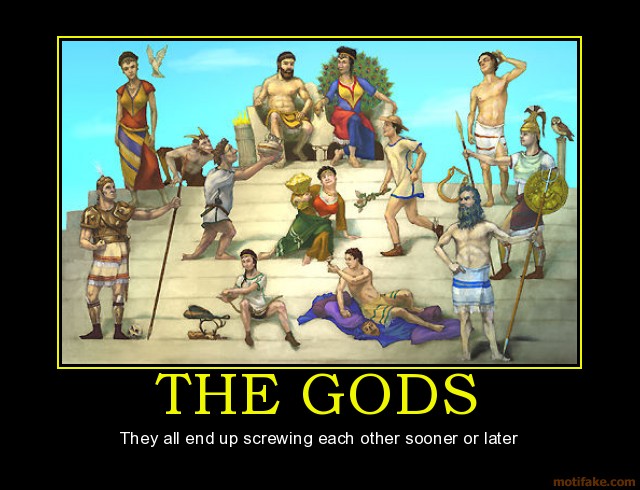
flesh of man touched by the gods. There are all sorts of stories of gods
accidentally creating miracles and beings with their blood, skin, bone and
other…less savory body parts. (Aphrodite being said to be a combination of
Kronos’s gelded bits and sea foam springs queasily to mind.) Who’s to say these
same dogs, who are named and given identities in the original myth, could not
have been transformed by one goddess’s thoughtless curse? Who is to say that
these animals would not be trapped in the form of men, condemned by their own
nature to be stuck between two conflicting states to repent for murdering the
man who had taken them in? After all, the gods weren’t exactly particular when
it came to divine retribution. Much like many deities before and after them,
their mindset seemed to follow more along the lines of ‘general area
effect’ rather than ‘single person effect.’
And in any case, doesn’t that make
them so much more interesting? The idea of an animalistic man and a pack of
humanistic animals? I don’t know, maybe it’s just me.



No comments:
Post a Comment