Look to it brothers and sisters;
Look to the fire that illuminates the ending of the darkness.
As it climbs and ascends the edge of our awareness at the edge of our worlds and minds,
always remember that while its warming fingers
may caress our cheeks:
those same delicate touches
can so easily become blades
that cut and rend the very souls.
Know of it mothers and fathers;
this thing is both benign and deadly, to friend to foe and to strangers.
For as it has no pity, so too does it lack malice, knowable or unconscious.
Something that simply is cannot be bound by judgement nor value that it does not possess.
So walk with and follow me my sons and my daughters;
Follow this only guide we all have to keep at bay the shadows of the minds and the lands.
Until we light our own fires within, we have no choice but to trust.
Trust that which remains unaware unmoved uncaring by our existence our living our very being.
To blindly rely upon a power not our own is to feel, but not to know.
To think we grasp, but not to truly understand nor comprehend.
It will be a perilous journey though blackness to find illumination.
Until all that remains is what is what was what may yet come to pass.
Sunday, June 9, 2013

Friday, June 7, 2013
Hero or Anti-Hero: Therein Lies the Rub
In terms of
relatable story characters, nothing really seems to beat the Anti-Hero. If you
need someone to swoop down from on high and save everything or everyone that
needs them, even if it means that they must be put in difficult positions and
tax their moral stances to the utmost, these are often not the people you want
to turn to. In fact, you had best hope you don’t stand in their way for any
reason, because if they’re put in a corner, they’re not going to dig deep to
find some hitherto unknown well of courage and strength just waiting to come
into being. They will look for solutions. They will gradually (or rapidly
depending on the specific character) stop caring as to why you are standing in
their way. They will take you into account. And then one way or another, you
will be dealt with.
Now, I don’t
have a lot of sarcastic clip art or demotivational posters or even any links to
any dictionary definitions. Mostly because this is going to be third person
anecdotal about stories that are not widely available for free on the internet,
but also because this is something of a personal subject for myself. So without
further ado, let’s get right to it.
Whether
people admit it or not, their imaginations demand two things of them. A
purposeful story. A story with a pattern and a reason behind many if not all of
the things that happen within its framework. And secondly, their imagination
demands an increasingly complex framework for the underlying simple stories
that they tell and hear in turn. Don’t believe me? Think of one of your
favorite stories. Take your time, I’m in no hurry. For me one of my absolute
favorite stories is Catch-22; the quintessential parody of
war novels that still manages to make points that you almost think to yourself
seem entirely incidental to the entire overall arc, disjointed as the narrative
structure may be.
It is
ultimately the story of a single bombardier who becomes increasingly
disillusioned with the war effort and who ultimately deserts when the
opportunity presents itself to him. A very simple premise at its core. But it
introduces characters both major and minor that make it the world the story
inhabits increasingly and mind-bendingly complex. So complex in fact, that the
title became a synonym for an unwinnable situation where no positive outcome is
possible.
But in any
case, when the framework demands complexity and depth one of the only
reasonable places to look for it is in the main protagonist. One of the reasons
that Greek mythology continues to fascinate even today, and why even Norse and
Egyptian stories continue to circulate in the popular consciousness despite
having virtually no recognition as major religions anymore is certainly not
because of its historical significance. If that were all that was to it, so
many other religions would have survived as well, if only to keep a clear and
accurate timeline in mind when looking at the evolutions of human belief
systems.
So many of
the more fascinating stories that get taken into the hive mind of pop culture
and endlessly permutated and examined and rehashed over and over are not the
more traditional heroes, such as Perseus who slew the Gorgon or Theseus who ended the life of the minotaur in order to end the suffering inflicted upon Athens by Crete. (And even they had their more questionable moments...) No, it is their more questionable
companions such as Heracles, Achilles and even Odysseus. An extremely strong
man who only performs some of his most memorable and famous actions to avoid
being sent to the Hellenistic version of Hell, a man who chose eternal glory
over family life and dragged his defeated opponent Hector’s corpse around the
walls of the city behind a chariot before leaving his body to be eaten by
carrion purely to spite Hector’s family and a man who slaughters all of the
suitors who had attempted to woo his wife after he had been presumed dead for
over a decade as well as any handmaidens who had been ‘weak’ enough to fall for
their charms.
I don’t
know about anyone else, but that doesn’t sound like the actions of a very
heroic person. And yet still Heracles’s 12 labors are one of the most memorable
stories of ancient Greek heroism. Achilles is still considered such a sufficiently
awesome figure that he had metaphorical and physical weak spots named after his
heel. And Odysseus’s actions to, during and coming home from the Trojan War are
quite literally the stuff of epics. So what is it about characters like this
that attracts and inflames the imagination even when the characters themselves
are not particularly heroic?
It is
precisely the fact that they are not strictly heroic that makes them so
relatable, so interesting. Ultimately, despite their flaws and (sometimes
numerous) failings, they continue onward. They do things that we’d consider
questionable for dubious reasons, but they are still fundamentally good people
at their heart. They mean well. Mostly.
Even their
ideas of divinity weren’t beyond this treatment. The ancient gods were skirt
chasing, petty, easily angered juveniles who could take offense if you so much
as sneezed on their boots while licking the soles. But they could be kind too.
Aphrodite’s bring Pygmalion’s statue to life comes immediately to mind. As well
as Zeus’s bringing Dionysus to Olympus after accidentally killing his mother
and Hera’s willing adoption of Heracles. Not perfect by any means, just like
real people. And because of that constant striving for but equally constant
falling short of perfection, they were also far more relatable. Far more
understandable.
Complexity
which surrounds simplicity. Light and Darkness intertwined to create not one or
the other but a shade of grey. Unreality the skitters the edge of knowledge.
Fantastic creatures and actions that are driven by comparatively mundane and
straightforward thought processes. All of these serve to make the Anti-Hero in
many ways far more fascinating than the traditional protagonist of many a tale.
But that is a story for another time…
Wednesday, June 5, 2013
Dualism in Lycanthropy: A Synopsis
When people imagine supernatural
creatures, they don’t often imagine there could be two sides to them. Not using
the original material anyway. We don’t see people talking about how Dracula
might’ve had one of his brides rebel against him in order to protect humans or
hear speculation about how the creature might’ve been harassing his creator and
killing his family in order to prevent him from continuing to play god and thus
save humanity from being overrun by the inexplicably reanimated dead. But that’s
not so in the origin of the word Lycanthrope aka The origin of most well known
mythological creation/exploratory stories aka Greek “Hellanic
Yes” Mythology.
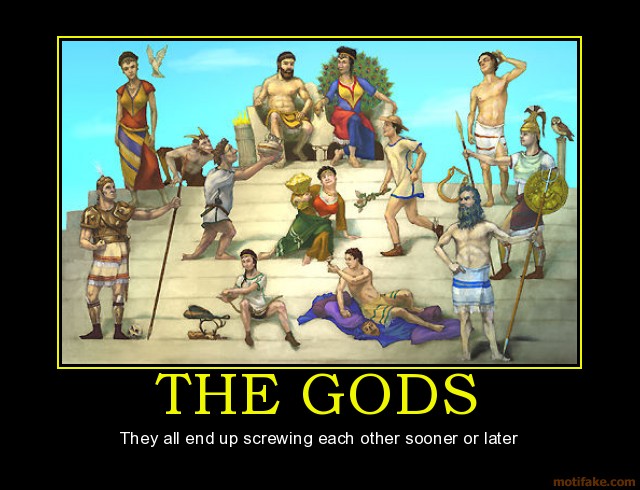
In Greek Mythology, there is one
original story for where werewolves came from. That is the story of king
Lycanos, the cruel king who verbally talked of disbelieving in the same gods
who had managed to lay waste to cities and turn a once beautiful priestess into
something so horrendously ugly that she turns to stone anyone who looks
directly on her and burns her image into any surface that reflects it back.
Zeus came down in mortal form and attempted to have him recant his doubt of the
gods. Lycanos, reasonable and logically thinking chap that he is, decides he’s
going to test the divine power of his guest by killing one of his sons and
feeding his flesh to the guest during the feast. Because cannibalizing your
children is usually the best way to
prove a possible god in mortal form is in fact a crazy man who’s off his meds.
Mostly.
Zeus, instantly remembering that
distasteful dining experience from the dive bar a few weeks back, instantly
recognizes the smell of cooked kid and so cursed Lycanos to become a wolf in
order to reflect his true ‘inner
bestial nature.’ A cruelly fitting end to a fittingly cruel man. And it
seems reasonable to assume that is the only instance of manmade monsters, or
monsters in man form. But that isn’t quite true, for in my mind there is still
another possible source of werewolves in Greek mythology: one who most anyone
even passingly familiar with the genre of ‘for the
love of everything holy, don’t ever spy on naked female dieties’ could
recognize. I am of course, talking about the story of Daphne the nymph
preferring to get turned into a tree rather than be yet another one hour stand
of the original sensitive musician god Apollo.

No wait, that’s the recognition of
another bad habit a lot of the male half of the pantheon seem to get into,
though I can’t for the life of me think of a name for it. No, the
story I’m thinking of is the story of Actaeon and Artemis. The hunter,
searching through the woods with his hounds, stumbles upon a sacred bathing
site of the goddess of the hunt. And so manages to see her in all her godly
glory. Apparently it wasn’t that much of a godly glory to see since she had to
personally intervene instead of simply waiting for her godly aura to vaporize
him ala Zeus in what is colloquially known as: “No wonder the wine god
constantly needs to get hammered in order to forget where he came from.”
Turned into a stag, his hounds chased and eventually tore him apart, seemingly
of their own will. But there are ancient beliefs that believe that if one
followed the teaching of Hecate, the ancient Titaness of witchcraft and
crossroads, there was a way to use the pelt of the wolf to transform into its
form.

Now, imagine that a wolf/dog/canine of some sort, managed to ingest the
flesh of man touched by the gods. There are all sorts of stories of gods
accidentally creating miracles and beings with their blood, skin, bone and
other…less savory body parts. (Aphrodite being said to be a combination of
Kronos’s gelded bits and sea foam springs queasily to mind.) Who’s to say these
same dogs, who are named and given identities in the original myth, could not
have been transformed by one goddess’s thoughtless curse? Who is to say that
these animals would not be trapped in the form of men, condemned by their own
nature to be stuck between two conflicting states to repent for murdering the
man who had taken them in? After all, the gods weren’t exactly particular when
it came to divine retribution. Much like many deities before and after them,
their mindset seemed to follow more along the lines of ‘general area
effect’ rather than ‘single person effect.’
And in any case, doesn’t that make
them so much more interesting? The idea of an animalistic man and a pack of
humanistic animals? I don’t know, maybe it’s just me.
Monday, June 3, 2013
Choice Background Expansion in the Name of NPC Awareness and Respect
If we’re talking about choices and consequences this week,
let’s talk about choice making video games. Because what better way to prove
that I’m a mature person than by taking a potentially serious topic and body
slamming it back down into the mat of childhood immaturity and giving it a rug burn
of utter…something to do with stereotypical assumptions of videogame player’s
inherent immaturity.

But in any
case, some of the best videogames I’ve ever played were ones where there was an
aspect of choice and player determination that felt like it affected the story
behind it. I’ve never really gotten into PC games such as World of Warcraft,
Mount & Blade or the Sims because the world is too open. Does that make
sense? No, of course not. After all, whoever heard of a thing as too much choice?
Don’t get
me wrong; if you want to play god, those games can definitely let you delude
yourself into believing it for a day. Or six. But ultimately, they have so much
choice that all the choices you make start to feel the same, that it becomes
too much like real life where many infinitesimal choices ultimately end up
weighing you down like a thousand pounds of feathers that never seem to matter
until they all lump together in a giant congealed…pillow…thing.
Games like
Alpha Protocol, Heavy Rain or inFamous on the other hand try to find a balance
between linear and open. In Alpha Protocol’s case, the freedom is expressed in
the player’s choice of background and interaction with a fairly linear settings
both within the context of the characters and the story that makes it feel like
part of a true espionage rpg.
In Alpha Protocol, you can choose
Thorton’s background and make him as awesomely stealthy or cringingly brazen as
you want but either way, you are a part of something bigger than yourself in
every aspect that while you affect and have a stake in, ultimately cannot end
on your own no matter how great you are. It leaves itself wide open while never
allowing the player to become paralyzed by indecision of how to piddle around
with the tranquilizer gun in order to make unconscious enemy soldiers wake up
in compromising positions.
In Heavy Rain, the interaction
between their characters, how quick their reflexes are and how much the one who
controls them believes they deserve to suffer or be rewarded is like taking a
microscopic look into a miniature drama between characters in the sims if the
sims could speak English and were significantly more memetic.
And in inFamous (1 and 2) how the
player controls Cole McGrath aka “The Electric Man” aka “The Demon of Empire
City” aka “The
Glitter Explosion that still lost to the Biology Experiment Riding
a Unicorn” directly affects what powers they can use to further their own
play style, their electricity turning either bright ocean blue or dark bloody
red depending on whether they decide they’ll treat the game as a hero fantasy
or grand theft auto with electricity catharsis.


All of these games have a world,
that while fairly linear and enclosed when viewed objectively, create an
atmosphere and background of underlying depth that allows the player to feel as
though they’re part of something bigger without overwhelming them with choice
and decisions. Just the way life could be…if that weren’t such a terrifying
prospect for everyone who’s Not the
main character of the world videogame.
Maybe you’d be the main character
in a videogame, maybe you’d be an npc. Personally, I love the genre, but that’s
not really the kind of world I’d want to live in. After all, as Danial O’Brian,
regular editor and writing contributor of cracked.com once said: “You
wouldn’t be the 17 year old lesbian cult leader, you’d be the water tower
painting peon.”
Subscribe to:
Comments (Atom)